

FIRE
mission statement
Vision
We are aware of thousands of educators, teachers, and institutions which have already implemented progressive and innovative ideas into their work. It's our belief that the purpose of education is for the exploration of the young person's inner calling, the development of their absolutely individual potential, and their preparation, not simply for the acquisition of qualifications, but for life at say, 50 years old. The two words from the Ancient Greek aphorism sums up FIRE’S educational philosophy - 'Know thyself'. To this end, we respect all initiatives looking for fresh solutions in education and do not promote any particular approach.
It is our view that the time has come to see all these new initiatives come together as the mainstream of education. The priorities of post-industrial education have been mainly concerned with equipping the young person with the skills of literacy and numeracy, with the ability to memorise information and to recall this information at the exam desk, and then to follow a more-or-less linear track into further education, and hopefully into well paid work. These priorities now need to be radically re-assessed as the World Economic Forum (WEF) and global experts warn; 'anything that is routine or repetitive will be automated'- Minouche Shafik. Director of London School of Economics.
As Artificial Intelligence and robotics advance into ever greater levels of sophistication, humanity will need to re-define the meaning and purpose of education, employment, and leisure. The world of work will look vastly different from that of the previous two centuries as labour intensive work, technical skills, and administrative tasks become managed by AI and robotics. The task of education, and more specifically, the role of the teacher will need to be distilled down to those essential elements which computing intelligence and digital technology cannot access or provide. This future scenario should be taken as a positive and firmly optimistic perspective of human development.
The higher creative faculties of the human being can then be given the opportunity to develop alongside the exponential rise in AI's technical capacities. Education will need to respond urgently to these massive changes through building up and strengthening the following capacities and life skills. The mental
health of, not only children, but of society as-a-whole depends on cultivating these capacities. Again, the WEF calculated that if we don’t re-design our global education system we will end up with a billion unemployed people in 20 to 30 year’s time. Preserving the status quo is simply wasting the tax payers' money.
If we envisage post-industrial education as a small grey cube then the new essentials of education can be seen as the transformation of this grey cube into a large, transparent, semi-permeable sphere.
The three sections below move from 10 'philosophical' principles, to 10 educational aspects, and finally landing with 10 school-based, practical points.
The 'New' Essentials of Education
1. Flexibility / Adaptability
The next generation will be challenged in their resourcefulness and their ability to manage change. Those who are able to adapt quickly and fluidly will fare better than those who struggle with spontaneity.
2. Creativity / Imagination
A move away from binary and linear thinking will need to be replaced by lateral and divergent thinking skills. New ideas, and the solutions to post-industrial problems, will arrive not through the thinking which created those problems but through the cognitive agility which can move into other, as yet unexplored, artistic / scientific dimensions.
3. Collaboration / Cooperation
The communications revolution has presented the very real opportunity of networking and the sharing of knowledge and ideas. The old form of students sitting isolated behind desks will need to be supplemented by group-working on a micro level in the classroom and on a macro (global) level, eg conference Skyping.
4. Empathy / Compassion
The potentially isolating effects of digital screen technology and its tendency to one-sidedly intellectualise children will need to be balanced with the capacity for emotional intelligence. This begins at pre-school age and is probably the single biggest challenge to the well-being of children today. Free play, forum sessions, and collaborative learning all build the vital future skills of listening and dialogue. In short; relationship.
5. Resilience / Integrity
The transitory and fleeting nature of digital media make it necessary to build up attentiveness, concentration, will- power, and courage in children through healthy routine and incrementally introduced levels of challenge in all aspects of life. Learning to fail and learning quickly from failure are crucially important life-skills in the building up of resilience.
6. Critical Thinking / Independent Thinking
One of the greatest challenges of the future will be the ability to discern 'truth' through asking questions, and going beyond the particular information given. Fake news, virtual reality, and digitally manipulated media will present our young people with the need to exercise clear thinking and astute judgement through thinking 'outside-of-the-box'.
7. Synthesis / Overview
With the unprecedented availability of online information, young people will need to learn to distill large amounts of data and information and make meaning from often disparate sources and references. This may be a faculty akin to intuition and the ability to see 'the whole picture'.
8. Initiative / Courage
The danger of feeling an illusory sense of achievement in the realm of online work needs to be met with a call to 'make one's mark', a call-to-action, to see tangible results as well as learning to value process along the way.
9. Mindfulness / Centering
Now proven globally to be an antidote to 21st century stress, as well as a means to heighten all the above capacities, mindfulness and meditation can be introduced into education ( at the appropriate age ) in simple and highly effective ways to promote mental health and general well-being.
10. Balance
A broad and holistic education involves the full integration of what can be called 'head, heart, and hands'; the equal importance of the academic, the artistic, and the practical. Another perspective on this balance can be seen as the equal emphasis on cognitive, emotional and kinesthetic skills.
Pedagogical Principles
For these principles to work in any learning environment it is imperative that teachers, coaches or mentors are given the autonomy they need to work creatively, and for them to be fully supported by government. Through this they can become inspired, energised and highly effective educators. One of the single-most important factors in effecting change in schools is through teacher collaboration. This cooperative approach brings about dynamic and creative initiatives which enliven both the teachers and the students. Through potentising the essential aspects of education, teachers are then able to focus on the quality of learning rather than the quantity of material covered.
Equally important is the support of parents who, through discussion and cooperation with teachers, can help to create an innovative and fertile learning environment for their children.
1. Immersive Learning
Experiencing a subject, topic, or theme through immersion in a 3 to 4 week block of learning is more effective and certainly more meaningful than a 'compartmentalised' and potentially fragmented programme of individual subject lessons.
2. Self-Directed Learning
Allowing a degree of choice and direction in long-term, project-based-learning encourages curiosity, self-motivation, investigation, and ultimately an appetite for life-long-learning. This is the journey of teaching through coaching, then into mentoring and finally, facilitating the student into full autonomy. This alternative approach to the absorbing, recalling, and ultimately,the forgetting of information, is based on the gradual empowerment of the young person by means of self directed learning at the appropriate ages. Unfolding the child’s interests, and hopefully their passions, is one of the ultimate goals of a progressive education.
3. Assessment and Evaluation
Creating a rigorous assessment schedule which involves self, peer, and teacher evaluation encourages dialogue, self-reflection, and a self-knowledge in the student which can ultimately replace the need for testing, grading and exams. The former strengthens self-direction while the latter simply exercises the memory. Non-exam based learning relies fundamentally on inner motivation and strength rather than externalised 'carrot on a stick' rewards which have very little long-lasting effect. There are, at present, major international initiatives working together to create broad and innovative evaluation systems using at least 10 criteria for assessing creative thinking skills. These far surpass the narrow parameters which exclude so many children who have innate lateral and creative abilities.
4. Age Appropriate Learning
Discerning the different phases of child development helps in presenting appropriate and specific content. Meeting the developmental needs of the child with the right material can support the learning process enormously.
5. Minimising homework in the primary years.
Homework (or taking work home!) can be seen as encouraging a practice, and ultimately a work habit, which research has shown to be ineffective and even counter-productive to the digestion and integration of the work done during the day. In a 2013 research-study on Nobel Prize winners in the field of science, (https://craftcouncil.org/magazine/article/busy-hands-busy-brains ) it was found that 85% of these successful innovators practiced a hobby, art, or craft after work.
6.Experiential Learning
Making all learning as practical and experiential as possible brings concepts and ideas into a concrete reality, especially for the early and primary years. Unfolding the learning experience in the outdoors and in nature has a powerful harmonising effect on the children. The 'Outdoor Classroom' can be a potent force in education.
7. Narrative and Metaphor
Infusing teaching with story, narrative, metaphor, and imagery can wonderfully enhance the engagement of young people. Anecdotes, biographical elements, and making allowance for spontaneous and divergent discussions can bring the content alive in a learning situation.
8. Vertical Learning
Sometimes making the time for mixed-age groups and combined class projects working together can create a much more dynamic learning environment. Older children can act as 'mentors' and role models for the younger years and those younger children raise their own expectations of their work and their social skills.
9. Free Play and Breathing Spaces
In the younger years, free play is critically important in developing the skills of lateral thinking, problem solving, empathy and cooperation, resilience, adaptability, and probably all the afore-mentioned human capacities. Free play is a key factor in the protection of childhood. In the older years, short 'breathing spaces' between sessions help to settle and to re-engage learning again with vitality and interest.
10. Interdisciplinary Learning
Drawing out many aspects and disciplines from one central theme or topic helps children find meaning and context, relationships and connections between seemingly disparate areas of study. A practical project, or a drama performance for example, can supplement the learning of maths and languages, the arts and humanities and the sciences. This becomes the all important cognitive faculty of 'whole-brain-thinking'.
Practical Suggestions
Every school or learning environment has its own particular 'landscape', its signature, and its own unique character. Each learning centre has its strengths and its challenges. It is important to build on those strengths and gently meet the challenges and 'gaps' in each school. The suggestions below are only indications based on the different models, philosophies, and educational influences which have steered the direction of our forum. It should be stated here that when one moves out and away from desk-bound- learning into a more fluid and creative learning environment the logistics become more complex and obviously more challenging. If one is successful in this transition, however, the rewards are significant.
Careful planning, the acquisition of resources, and the building in of strategies is essential. Again, the analogy of the movement from a small grey cube to a flexible and transparent sphere is appropriate here. Spontaneity and creative freedom function best when they happen within a safe and clear structure.
1. The Forum or Circle
A very potent and central activity within the school week can be the Forum or 'talking circle'. Its value cannot be overestimated but only when facilitated with discretion and sensitivity. The weekly opportunity for students to engage in discussion, debate, the sharing of current issues in the class, and even personal challenges is invaluable. The Forum can become the 'hidden gem' amidst the busyness of the school life!
2. The Opening Activity
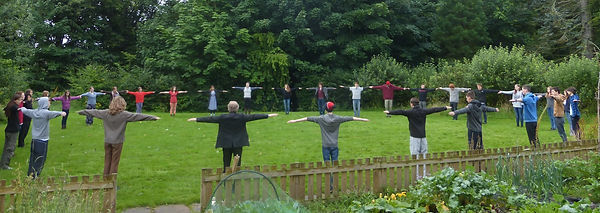
Many children find it difficult to 'wake up' or 'arrive' during the first part of the day after a car journey to school and especially during the adolescent years. Opening the day with some mindful movement, a two-part song, or the recitation of a poem refreshes and invigorates the children (after some initial reluctance!) so that the day's learning experiences are absorbed much more deeply.
3. Learning Outdoors
Spending at least half a day of the week learning outside and preferably in nature can add another vital ingredient into a school environment which focuses on well- being. If this isn't possible, then breathing spaces between sessions can be timetabled in for a 5 to 10-minute outdoor break. The time 'lost' is well worth the investment as restless and energetic children settle back into the next lesson refreshed and ready to engage again.
4. Semi-permeable Schooling
Loosening the rigidity of post-industrial education involves creating a two-way interface as the world flows into the school environment through inspirational speakers and the students go out on school trips. Regular visiting speakers can enliven and inspire young people and again, bring a relationship and connection to the world outside. Similarly, taking groups out for short excursions to local sites and resources can help to expand 'the tiny grey cube of education into a large transparent sphere'.
5. ICT Learning
Digital resources in education are best used in a structued and regulated way. Screen exposure can become compulsive and lead to the growing need for instant gratification. Age appropriate introduction of ITC into the classroom should be sensitively considered. If new technologies are specifically targeted and well- structured into a lesson they can lead to efficient use of screen time leaving more time for live and interactive learning.
6. Individual Study / Group Collaboration
A fine balance between individual study and collaborative group projects prepares the students for a future when co-operation and the bridging of potentially conflicting paradigms will be amongst the key skills needed in the future. Designing group learning or problem solving projects have a deep social value alongside the development of creative thinking skills which are not accessible from the 'desk and textbook' model of education.
7. The Outdoor Classroom
The Outdoor Classroom can be both a physical open-sided shelter within the school grounds or in the immediate vicinity. It may be the whole local environment depending on the school's resources. A large open shelter is a valuable asset to a school as it can facilitate many opportunities for experiential learning through practical activities. Craftwork in green wood, willow, wool, clay and even iron are primal activities which resonate deeply with teenagers and children depending on the material being worked.
8. The Mini Project
On a Monday the students come to school prepared with a question. It may be practical, technical, academic, philosophical or even existential and they present this written question to the rest of the class. On Tuesday and Wednesday the students research their particular question using books, online resources, asking informed people, and on Thursday each student presents their findings in a short 10 minute lesson to the rest of the group. Friday is devoted to writing up their process, their findings, and their conclusion in a pro forma report document. This exercise has many valuable aspects including peer teaching and learning and also confidence building in presenting one's 'self' to a large group. It is also a necessary step in formalising and recording the week's work.
9. Independent Projects
The school year's programme can be divided into 3 to 4 week blocks of topic based learning when the teacher/s facilitate the interdisciplinary learning of a certain theme. Many different subjects and skills can be drawn out of this central theme if the block is designed and planned creatively. These cohesive blocks of learning can also have a self-directed learning element to them as each student takes up one aspect within the block which is of particular interest to them.
The year-long Personal Project can be introduced for high school students when they take on the responsibility of researching a topic of their own choice and presenting it at the end of the last term of school. This presentation has three components; the written document (increasing in word count with each grade), a practical or artistic response to the topic chosen, and a verbal presentation to the class, later to the school, and finally in a public venue.
10. Free Play in Primary Years
Free play is vital for early years development and its benefits cannot be overstated. Physically, emotionally and cognitively, free play promotes the foundational base for all future learning. Resilience, ingenuity, resourcefulness, collaboration, primary and tactile experience of the physical world, the potential to learn empathy, and the development of imagination towards future lateral thinking are just a few of the 'soft skills' which are learned through free play.
Play, researchers suggest, is children’s default setting, their way of engaging with the world. It can contribute to the development of resilient capacities such as emotion regulation, stress response systems, attachment and an openness to learning. In addition,
play’s great contribution to life is its vitality and the pleasure it brings. This is more than a luxury, it gives us all a greater satisfaction in being alive. Children who can find time and space to play are more likely to be happier, more settled and more engaged in other aspects of school life.
In a play-friendly school, play is recognised, valued and supported in all its forms and across all of school life. This includes providing dedicated times and spaces for playing, and, where appropriate, making use of playful pedagogies as well as valuing and working with playful moments that may emerge in the course of everyday school life.


MAKE YOUR IMPACT WITH FORUM FOR INTERNATIONAL RENEWAL OF EDUCATION
 |  |  |
|---|---|---|
 |  |  |